Comparison
- 13 min read
- Updated: 12/10/2025
Makita SP6000J vs SP6000J1
What are the differences, and which one should you choose?
- Quick access to the best prices
- In brief
The Makita SP6000J and the SP6000J1 are two versions of the same plunge saw: no technical differences, only the contents of the package change.
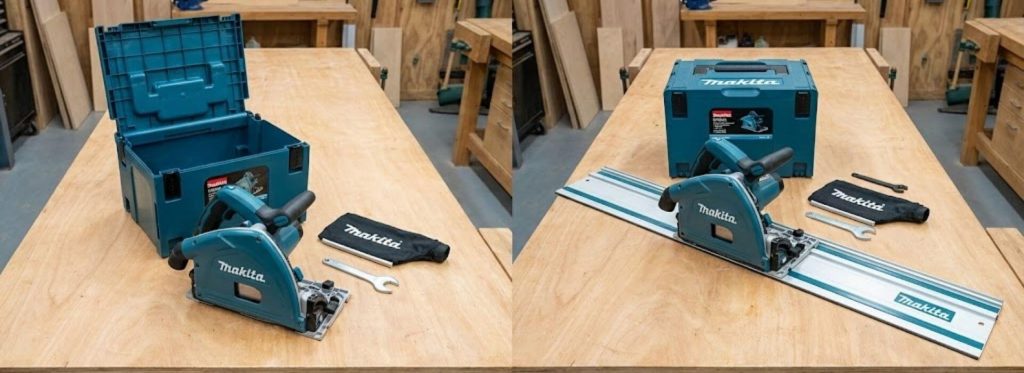
■ SP6000J: the saw + the Makpac case, without a guide rail. Ideal if you already own compatible rails or want to build a custom kit.
■ SP6000J1 : the saw + the case + a guide rail (usually 1.4 m). Designed to get started right away, especially if you don’t already have any equipment.
Track plunge saws have replaced the traditional circular saw in many workshops. Cutting melamine panels, worktops, doors, and cladding: the Makita SP6000 has become something of a standard among carpenters and cabinetmakers.
But when you start comparing references, two model codes keep coming up: SP6000J and SP6000J1. Same power, same blade, same look… so why two models, and which one is really worth considering?
What the two models have in common
Makita does not offer two different saws, but the same machine available in several package options. The core technical specifications are therefore identical.
Motor and capabilities
- Rated power: 1300 W
- No-load speed: approx. 2,000 to 5,800 rpm
- Blade diameter: 165 mm
- Bore diameter: 20 mm
- Cutting depth at 90°: 56 mm
- Cutting depth at 45°: 40 mm
- Cutting depth at 48°: 38 mm
Comfort and safety
- Soft start and an electronic speed controller to maintain constant speed under load.
- Anti-tip safety feature for bevel cuts on the guide rail.
- Tool-free adjustments with clear, readable graduated scales for depth and angle.
- Noise level of approximately 102–103 dB(A) sound power, 91–95 dB(A) sound pressure.
Rail compatibility
The base plate is designed to work with Makita guide rails and is also stated to be compatible with rails from other manufacturers.
- Conclusion
From a mechanical standpoint, the SP6000J and SP6000J1 are therefore the same plunge saw; only the accessories included in the box differ.
The real difference: what’s included in the box
Where everything comes down to is the package contents.
- SP6000J
Saw + Makpac case
- Plunge saw SP6000
- 1 × 165 mm blade
- 1 × wrench / hex key
- 1 × Makpac case (Type 4, depending on the retailer)
- No guide rail included
≈ $290
- SP6000J1
Complete kit
Saw + case + guide rail
- Plunge saw SP6000
- 1 × Makpac case
- 1 × guide rail (approx. 1.4 m or 55")
- Sometimes included: clamps, rail bag, or rail connector.
≈ $370
Best value for money
- Our choice
Accessories included in the SP6000J box
Makita B-69864 EFFICUT
165 × 1.85 × 20 mm blade – 60 teeth – 10° angle
≈ $39
Makita 783217-7
5 mm hex wrench (series 742)
≈ $10
Makita 821552-6
Stackable Makpac case Size 4 (durable)
≈ $39
The exact length of the guide rail and the inclusion of extra accessories (bag, clamps) can vary by country and retailer. Always check the detailed kit contents with the seller.
When should you choose the SP6000J?
If you already own one or more guide rails (Makita, Festool, etc.), or if you plan to buy a specific rail separately, the SP6000J allows you to avoid paying twice for the same accessory.
Makita documentation indicates that the base plate is compatible with guide rails from other manufacturers, which opens the door to combinations like “Makita saw + rail from another brand.”
You want to build your kit “à la carte”
Some users prefer to:
■ buy the saw in the Makpac case,
■ then choose the rail length (1.0 m, 1.4 m, 3.0 m, multiple rails to join, etc.),
■ and optionally mix with rails already available in the workshop.
- SP6000J
1300W plunge saw + Makpac case
≈ $290
In this case, starting with the SP6000J and then adding the appropriate guide rails can be more cost-effective than the J1 pack, depending on local pricing. User discussions show, for example, that buying an SP6000J kit plus a separate rail can end up cheaper than the complete SP6000J1 kit in some countries.
When should you choose the SP6000J1?
The SP6000J1 is aimed more at those who want a ready-to-use kit right away, without having to overthink it.
You’re starting from scratch
You have:
■ no Makita guide rail,
■ no compatible guide rail,
■ and you want to cut panels cleanly straight out of the box.
The SP6000J1 package includes at least one guide rail matched to the saw, allowing you to start right away with straight, clean, and safe cuts.
You prioritize purchasing simplicity
Rather than:
■ choosing the saw,
■ searching for the correct guide rail reference,
■ checking compatibility,
- Recommended for beginners
- Makita SP6000J1 (complete kit)
Saw + Makpac case + 1.4 m guide rail
4.5 / 5
≈ $370
Price considerations: bundle or separate purchase?
The SP6000J saw by itself or in a case is logically less expensive than the SP6000J1 kit. The SP6000J1 kit adds up the price of the saw, the case, and the rail, sometimes with a small overall discount.
- Separate purchase vs kit simulation
SP6000J (saw + case)
≈ $290
+ Makita 1.4 m guide rail
≈ $59
Total separate purchase
≈ $349
SP6000J1 kit
≈ $370
- Savings with the J1 kit
~$71 saved with the kit
■ In some countries, it is more financially advantageous to buy the SP6000J with a case plus a separate rail than to buy the SP6000J1 kit outright.
■ In others, the SP6000J1 is offered at an aggressive price and becomes the best choice in terms of “price / simplicity.”
Because prices constantly change with promotions, it’s wise to compare:
■ Price of the SP6000J in a case
■ Price of a 1.4 m Makita guide rail (or whatever length you want)
■ Price of the SP6000J1 kit
Cut quality and real-world use: are there any differences?
On paper, there’s no difference in inherent performance: same motor, same electronics, same cutting capacity.
Cut quality will mainly depend on:
- The condition and quality of the blade
- The rail’s stability
- Depth setting (anti-splinter position)
- Your technique
Whether you have an SP6000J or an SP6000J1, on the same rail and with the same blade, the result will be identical.
In summary: SP6000J or SP6000J1?
Choose the SP6000J if:
- You already have compatible guide rails
- You want to build a custom kit (rail lengths, accessories)
- You find a better deal buying the SP6000J plus a separate rail than the J1 bundle
Choose the SP6000J1 if:
- Recommended
- You’re starting from scratch
- You prefer the simplicity of a complete kit (saw + rail + case)
- You want to be ready to go straight out of the box without worrying about rail references
In both cases, you end up with a well-regarded, precise plunge saw, capable of competing with the most high-end guide-rail systems for cutting panels, countertops, and precision woodworking.
Frequently Asked Questions
Are the SP6000J and SP6000J1 two different saws?
No. The plunge saw is the same in both references. The differences are only in the accessories included in the case.
What is the main difference between the SP6000J and the SP6000J1?
The SP6000J does not include a guide rail in its standard kit. The SP6000J1, on the other hand, is typically supplied with a guide rail (often 1.4 m) in addition to the Makpac case.
Do the motor and performance change between the two models?
No. Same power (1300 W), same variable speed, same cutting depth. There’s no performance advantage tied to the choice of kit.
Does the SP6000J work without a rail?
Yes. You can make cuts without a rail, but the precision and edge quality will be lower, as with any plunge saw.
Does the SP6000J1 always include a 1.4 m rail?
The rail length can vary depending on the retailer (1 m, 1.4 m, or 1.5 m depending on the country). You should check the seller’s detailed listing to confirm.

About the author
Article written by Quentin François, a DIY enthusiast for over 10 years, and author of practical guides tested in the workshop.
Glossary
Plunge saw
A tool that allows the blade to be lowered vertically into the material, enabling clean cuts in the middle of a panel or along an edge, with precise depth control.
Guide rail
An aluminum profile on which the saw slides without play, ensuring a straight path and repeatable cuts. Essential for laminated panels, visible edges, and long cuts.
Makpac
A stackable storage case used by Makita. It allows easy transport of the saw and its accessories and interlocks with other cases in the range.
Plunge action
The motion that lowers the saw head until it reaches the preset cutting depth. Commonly used to create openings in countertops (sink cutouts, cooktops, etc.).
Cutting depth
The maximum thickness the blade can cut through. It depends on the angle (90°, 45°, etc.) and determines which materials can be cut.
Anti-tip device
A small mechanical feature that prevents the saw from tipping when cutting at an angle on a rail, especially useful during fast or bevel cuts.
Soft start
An electronic function that prevents jerking when the motor starts. Speed increases gradually, helping stabilize the tool.
Electronic speed control
A system that maintains blade speed even when cutting into dense material. It helps reduce burning, tear-out, and uneven cuts.
Bevel cut (or miter cut)
Tilting the saw to a set angle, typically between 0° and 48° on the SP6000. Used for precise joints and fittings.
165 mm blade diameter
A standard blade size for compact plunge saws. The 165 mm diameter determines cutting depth range and cut quality.
20 mm arbor
The diameter of the blade’s center hole. It must match the motor shaft to ensure proper mounting and vibration-free operation.
Splinter guard
A rubber strip along the edge of the guide rail designed to prevent chipping on delicate surfaces (melamine, laminate, veneer).
Rail clamps
Accessories used to secure the rail to the workpiece. They prevent movement during long or angled cuts.
Rail connector
Metal rods or profiles used to join two rails together to achieve longer cutting lengths (2.8 m, 3 m, etc.).
Cross-brand compatibility
The concept that some saws can run on guide rails from other manufacturers. The SP6000 is often cited as being compatible with multiple rails, but actual compatibility depends on the exact rail profile and should be confirmed by the seller or tested.
Transparency: This article contains affiliate links. If you purchase a product through these links, we may earn a commission at no additional cost to you. This helps us maintain this website and produce high-quality content. We only recommend products we consider reliable and relevant.